


Generally, increasing the flow rate under the same pressure conditions produces a larger droplet diameter. Increasing the pressure reduces the droplet size, as does the increase in spray angle.
ATOMIZER CLASSIFICATION
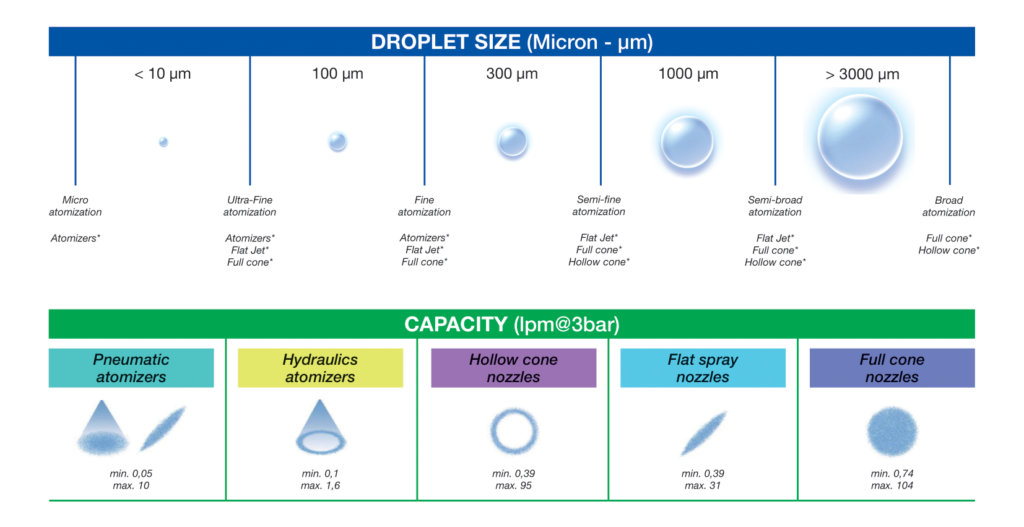
The main factors affecting the droplet diameter of an atomizing device are flow rate, pressure, and atomization type.
We can obtain the smallest droplets with air atomizing atomizers and the largest ones with full cone nozzles. The following table shows the droplet diameter average; for each spray pattern, the minimum and maximum flow rate values at 3-bar pressure.
THE HYDRAULIC AND PNEUMATIC ATOMIZER
The task of an atomizer is to fractionate the droplets of the liquid to obtain smaller droplet diameters than standard spray nozzles.
We can classify atomizers into two macro-categories: hydraulic and pneumatic.
1. HYDRAULIC ATOMIZER
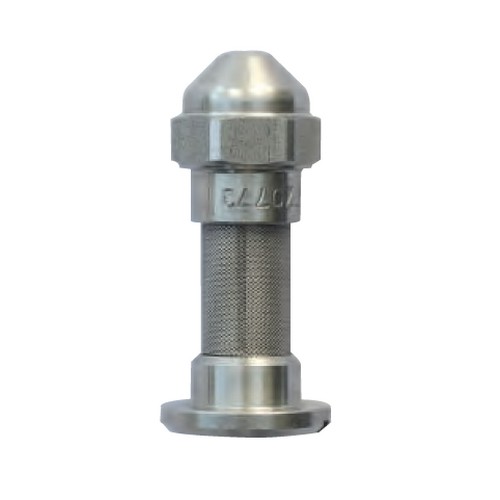
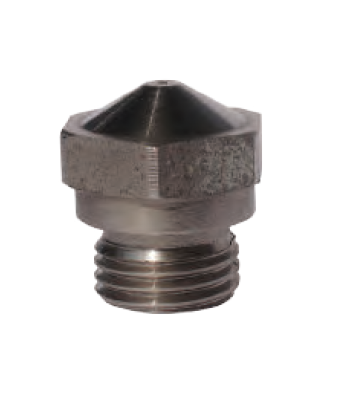
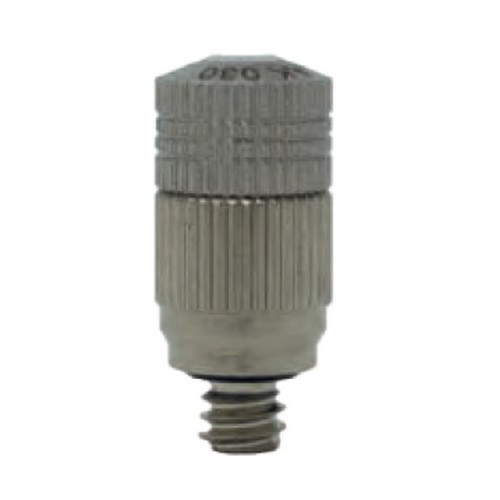
Hydraulic atomizers allow you to spray the liquid extremely finely only with hydraulic pressure. In general, the force used in hydraulic atomizers is medium-high, and the higher the pressure, the smaller the diameter of the droplets.
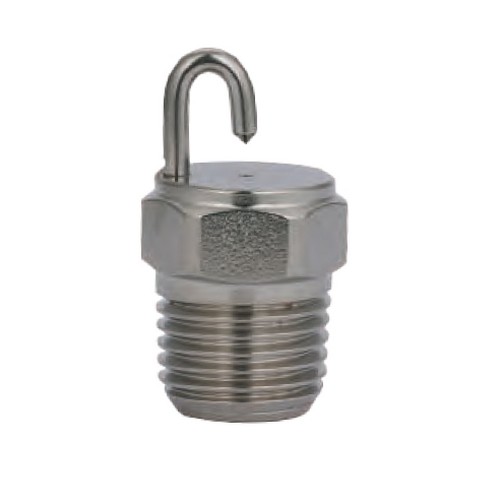
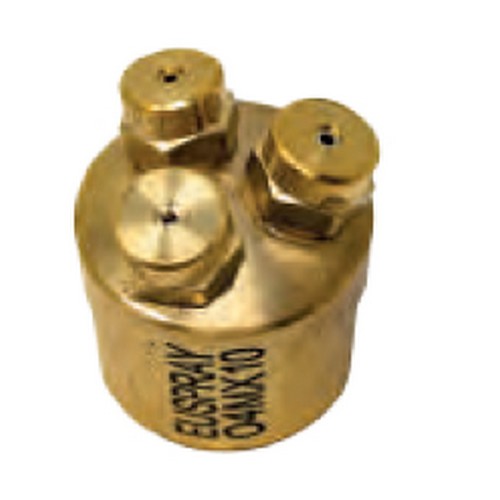
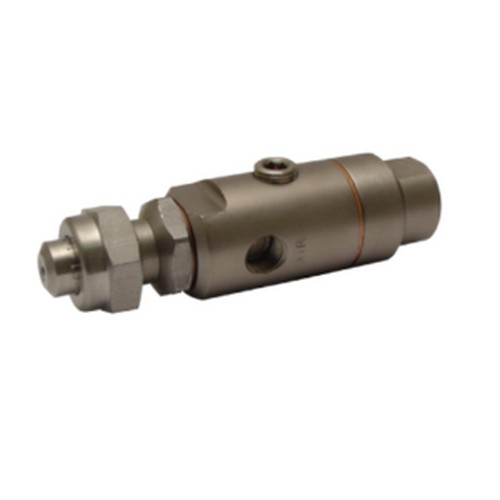
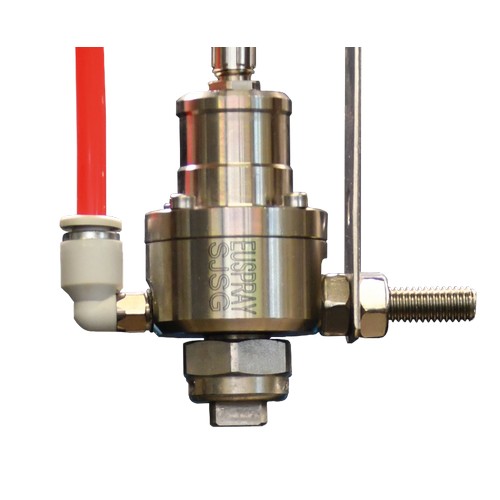
Euspray range offers standard, automatic, and electrohydraulic atomizers.
STANDARD HYDRAULIC ATOMIZER

AUTOMATIC HYDRAULIC ATOMIZER

ATOMIZER ELECTROHYDRAULIC MODEL

2. PNEUMATIC ATOMIZER
Pneumatic atomizers mix compressed air (or other gases) with the liquid to be sprayed, producing a fine atomizing spray. Depending on the pressures and the liquid used, the diameter of the droplets may vary. The pressure used with pneumatic atomizers is relatively low and rarely higher than 3 bar.
The spray combination of the pneumatic atomizer consists of a configuration; It consists of a liquid nozzle and an air nozzle that determine the different flow rates, the type of mixture (internal and external mixing), and the shape of the jet.
- Internal mixing in the atomizer
With internal mixing, the spray liquid is mixed inside the air nozzle to produce a perfect atomizing spray. The working pressures of the air and liquid are closely related and significantly affect the spray pattern.
Many spray options are possible for the atomizing nozzles and shape types that are possible:
- Full cone
- Hollow cone
- Flat spray
The supply can take place by pressure, by fall, or with the Venturi effect.
- External mixing in the atomizer
With the external mixing, air and liquid mix outside the air nozzle. In this case, air and liquid pressures; are not related.
This nozzle type is particularly suitable for applications with high-viscosity and density liquids or with the presence of small solid particles.
The available spray types are:
- Flat jet
- Full cone
Within the family of pneumatic atomizers, the Euspray range offers different models to meet all misting needs in any application.
E- TYPE SPRAY NOZZLES
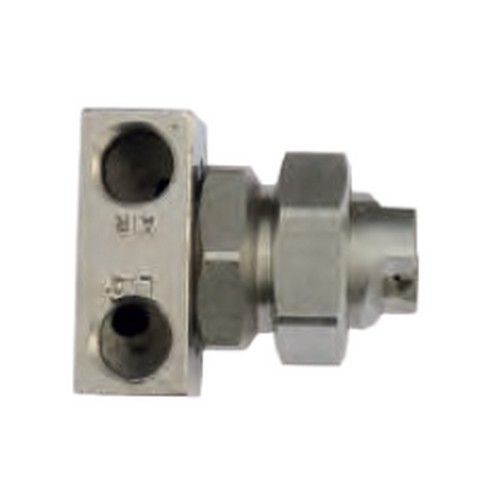
E family atomizers; can be manufactured in brass with nickel-plated surface treatment, AISI 303, and AISI 316L (other materials, on request).
Depending on the application and the need for atomizing, the E range offers the possibility of inserting an adjustment adjustment needle to regulate, partial or complete, the liquid inlet or a nozzle cleaning needle excellent for applications where the liquid can cause the nozzle clog.


P-TYPE AUTOMATIC GUNS
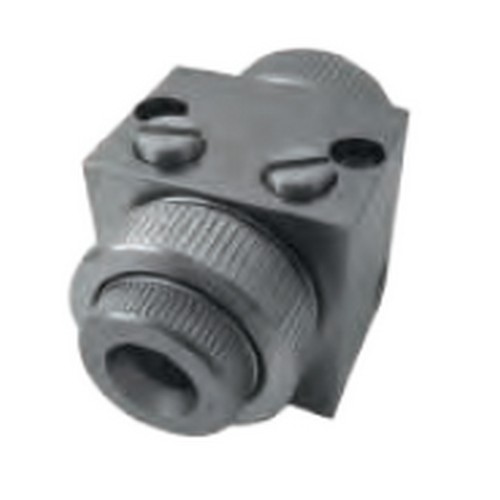
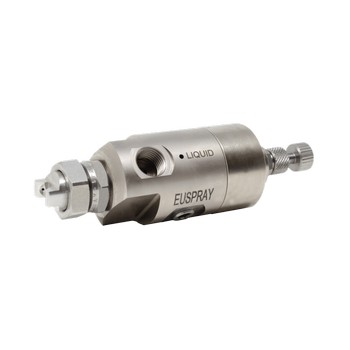
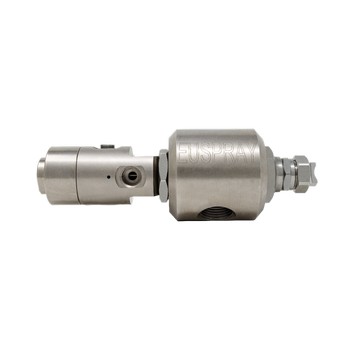
Automatic guns allow you to dose the opening and closing of the liquid over time. This operation; is achieved by a compressed air cylinder inside the spray gun that can have up to 100 operations per minute.
If necessary, in some models, besides performing ON-OFF operations, the needle also cleans the hole.



ATOMIZER ELECTRO-PNEUMATIC MODEL

ATOMIZER MODEL MICRO
The MSGA series; has been developed to achieve exceptional reliability while maintaining the extremely tiniest dimensions. This micro atomizer is made entirely in SS 316L, with every seal in contact with the liquid; made in FKM or Kalrez®, an elastomer especially appreciated for its resistance to chemical agents.

ULTRASONIC ATOMIZER
Ultrasonic atomizers guarantee the smallest droplets on the market. Thanks to the resonator in front of the outlet hole, the drops are further fractioned, ensuring an ultra-fine atomizing spray with even distribution.
These ultrasonic atomizers can be supplied with different atomization angles and adapters, depending on the application and the area to be covered.

INDUSTRIAL APPLICATIONS OF THE ATOMIZER
Potential applications of an atomizer are varied and include any application that requires extremely thin atomizing or mist.
Typical applications:
- Lubrication
- Cooling
- Cover
- Cloak
- Humidification
- Dust suppression
- Odor control
- Deodorizations
All industries can benefit from these nebulization types, and Euspray technicians are available to discuss their needs and requirements for air atomizing systems.