The spray nozzle transforms the energy of a liquid into kinetic energy. The kinetic energy is utilized to break the liquid in little particles and to disperse them evenly according to the desired pattern.
In some cases the kinetic energy is used to give higher penetration force to the jet The nozzle also allows to obtain pre-set capacities according to the pressure as you can see in the tables in this catalogue.
The capacity depends on the internal flow area and on the working pressure. In general the relationship between the capacity and the pressure is the following:

Q1 and P1 are known capacity and pressure.
Q2 is the resulting capacity at desired pressure P2.
All the tables of the catalog are based on water.
For liquid with a specific gravity other than 1 multiply the catalog water capacity by the following conversion:
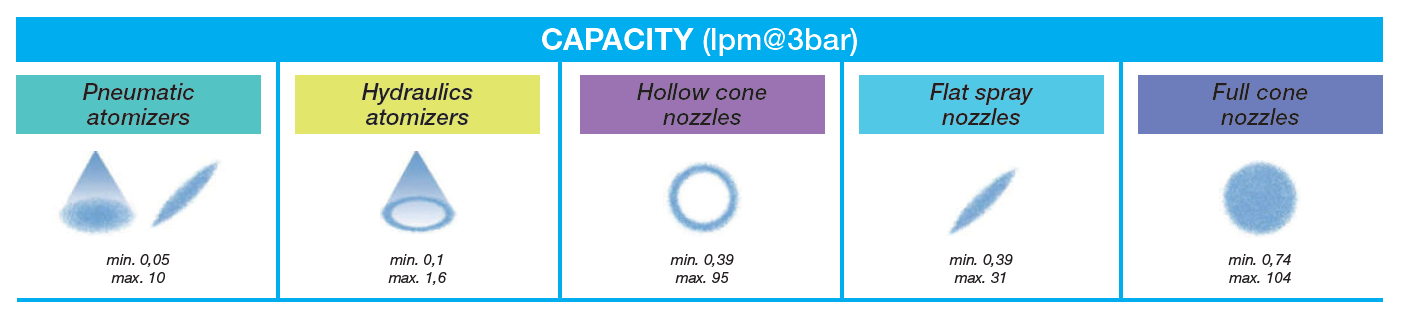
It is available a wide range of nozzles suitable to solve every kind of your spray problems. So you can choose different spray patterns, and precisely:
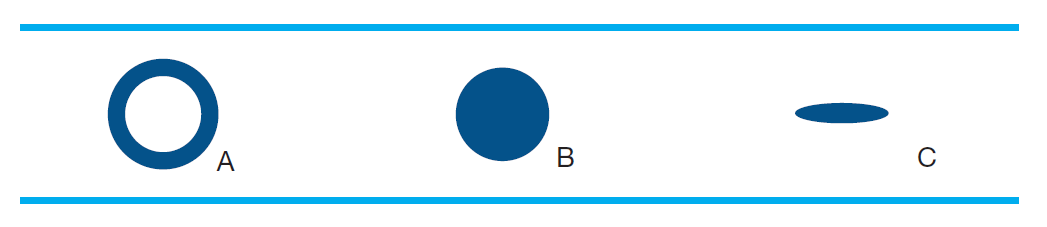
- Hollow cone spray: type A
The liquid particles are distributed evenly forming the outer shell of a hollow cone. The area covered by the spray, falling perpendicularly to the jet, is in this case a circumference whose diameter is relative to the distance of the nozzle and the spray angle.
- Full cone spray: type B
In this type of spray the internal part of the cone is also filled evenly with liquid particles. The area covered by the spray,falling perpendicularly to the jet, is in this case a circle whose diameter is relative to the distance of the nozzle and the spray angle.
- Flat jet: type C
In this type the area covered by the spray falling perpendicularly in an elongate elliptical shape. The dimension of the lateral axis is relative to the distance between the nozzle and the covered area. The dimension of the longitudinal axis is relative both to the distance from the nozzle and the spray angle.
- Atomizing nozzle: type E
In these nozzles the compressed air is mixed with the liquid to provide a fine atomization. From the tables you can choose the type of atomizer which better satisfies your specific requirements.
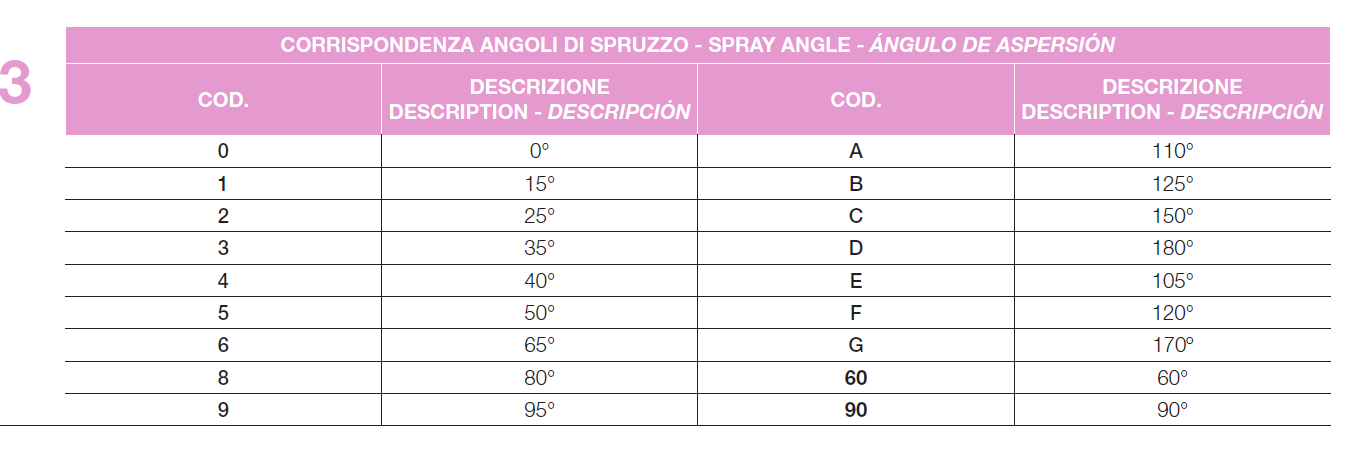
The spray angle is generally measured near the orifice. By increasing this distance, the measurement of the width of the jet becomes less precise due to the effect of gravity and environmental conditions. It should also be noted that an increase in the viscosity of the product to be sprayed reduces the spray angle.
The tables show the theoretical coverage at various distances, depending on the spray angles.

The major factors affecting droplet size are the capacity, the pressure and the spray pattern. Usually an increase of the capacity, under the same conditions of pressure, produces larger droplet size. The increase of the pressure reduces the droplet size, as well as the increase of the spray angle.
Air atomizing nozzles produce the smallest droplet size, full cone nozzles produce the largest droplet size. For every spray pattern, the table shows the average droplet sizes relative to the minimum and maximum capacity values, with a pressure of 3 bar.
The spray impact depends on capacity, pressure and spray pattern. The highest impact is produced by solid stream and flat spray, the lowest one by wide full and hollow cone.
The wear effect produced on the nozzle orifice determines an increase of capacity. Under the same conditions, stainless steel life is five times longer than brass.
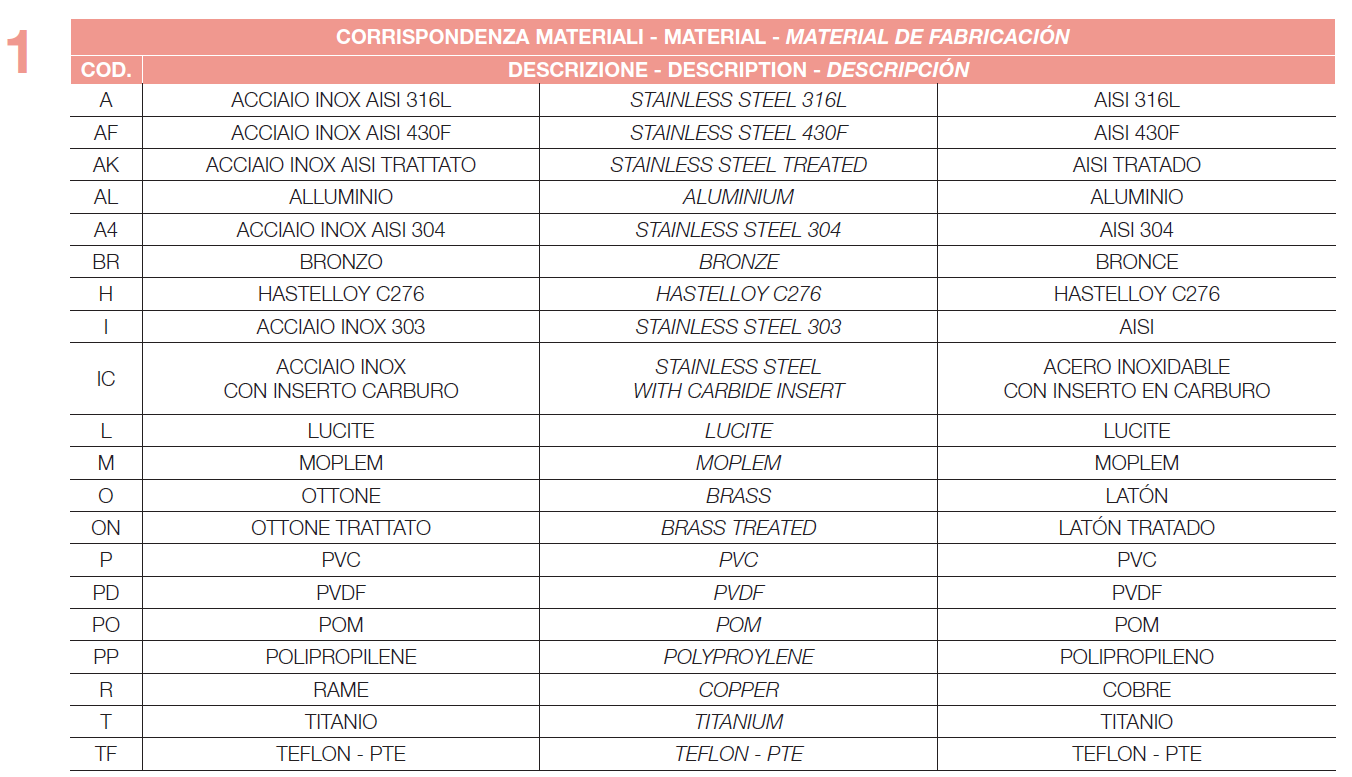
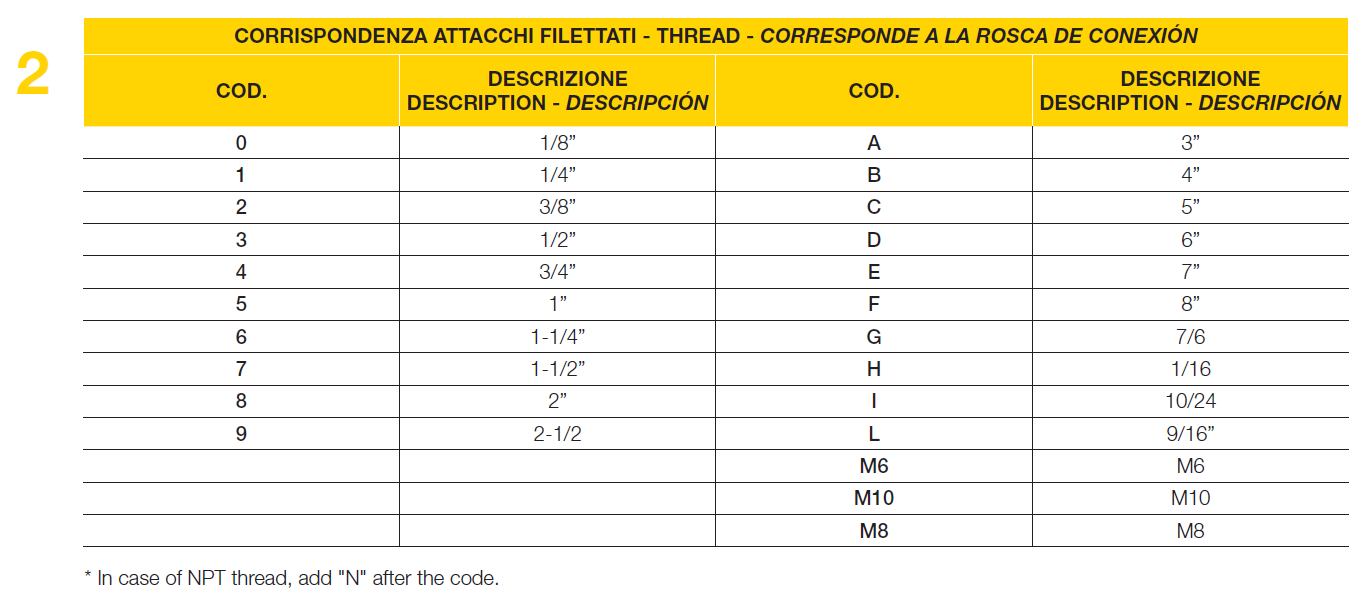
The standard material of our product is indicated on the table 1. Eurospray may also supply the nozzles even with non-standard material according to the customer’s request. EUROSPRAY’s products are identified by 11 alphanumeric characters.
NB: The material for high pressure nozzles MC4-C4 and HP is not listed, so the article code starts with the thread or the model (Example: C4-020 – 1HP022)
* Only for flat jet